the betty hill star map, recomputed
i've been building star focus: productivity timer, an ios app that flies you to real nearby stars during focus sessions. it's a focus timer for people who code, write, or design for a living. anyone who needs long quiet stretches of attention. i wanted something more interesting to look at than a tomato icon.
you can fly to ambient music. you can turn the star labels off and just sit with the void.
the phone builds a real 3d map of the local stellar neighborhood from the hyg catalogue, which gives me coordinates, distance, luminosity, and mass for many thousands of stars out to ~1,000 light-years from the sun. the nasa exoplanet archive fills in which stars have known planets. everything you fly past in the app is a real star at its real position. not randomly generated noise that happens to look like stars.
so lately i've spent a lot of evenings staring at 3d models of the neighborhood. and one evening, scrolling through it all, i remembered a story i'd half-known for years and never actually checked.
so i checked.
the story
this is the betty hill case, one of the most famous in the entire ufo/uap literature.
september 1961. us route 3, in the white mountains of new hampshire. betty and barney hill, a couple driving home at night, lose two hours.
over the following months they start recalling, eventually under hypnosis, that they had been taken aboard a ufo/uap. betty remembers one of the aliens pulling a map out of the wall and showing it to her. three-dimensional, “almost like looking out a window,” with dots scattered all over it and curved lines connecting some of them. when she asked what the lines meant, the alien told her that the heavy ones were trade routes and the thin ones were exploration routes to other worlds.
two of the dots were “as big as nickels.” when she asked where the aliens came from, they pointed at the map. then they asked her where earth was. she couldn't tell. they put the map away.
in 1964, under post-hypnotic suggestion, betty drew what she remembered:
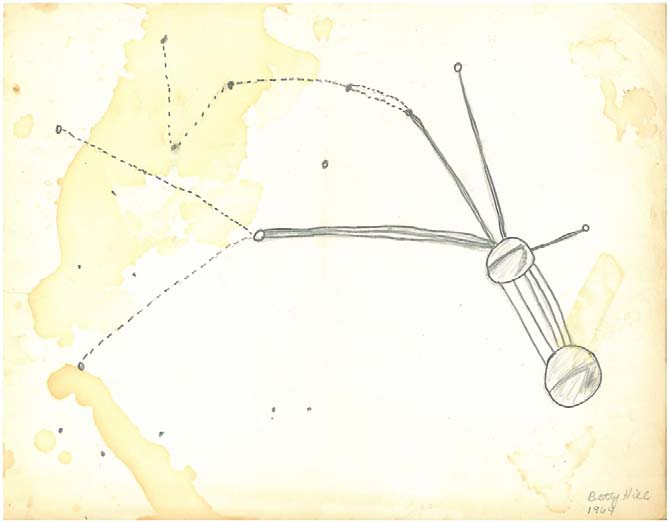
the case is one of the most documented ufo/uap encounters in history. it has its own extensive wikipedia article, a 1966 bestseller (john fuller's the interrupted journey), a 1975 tv movie, and an archive of materials at the university of new hampshire library.
marjorie fish
a few years later, an elementary school teacher in ohio named marjorie fish got interested in the case. she bought the 1969 gliese catalogue of nearby stars, narrowed it down to 46 sun-like candidates within 55 light-years of earth, and started building three-dimensional models of their positions out of fishing line and beads in her living room.
she moved her head around the model for five years.
in 1973 she announced she had a match. the “two nickel-sized” foreground stars were zeta¹ and zeta² reticuli, a wide binary in the southern sky. the camera that took betty's view of the sky was sitting just above them, looking back toward earth.
this is what she ended up with:
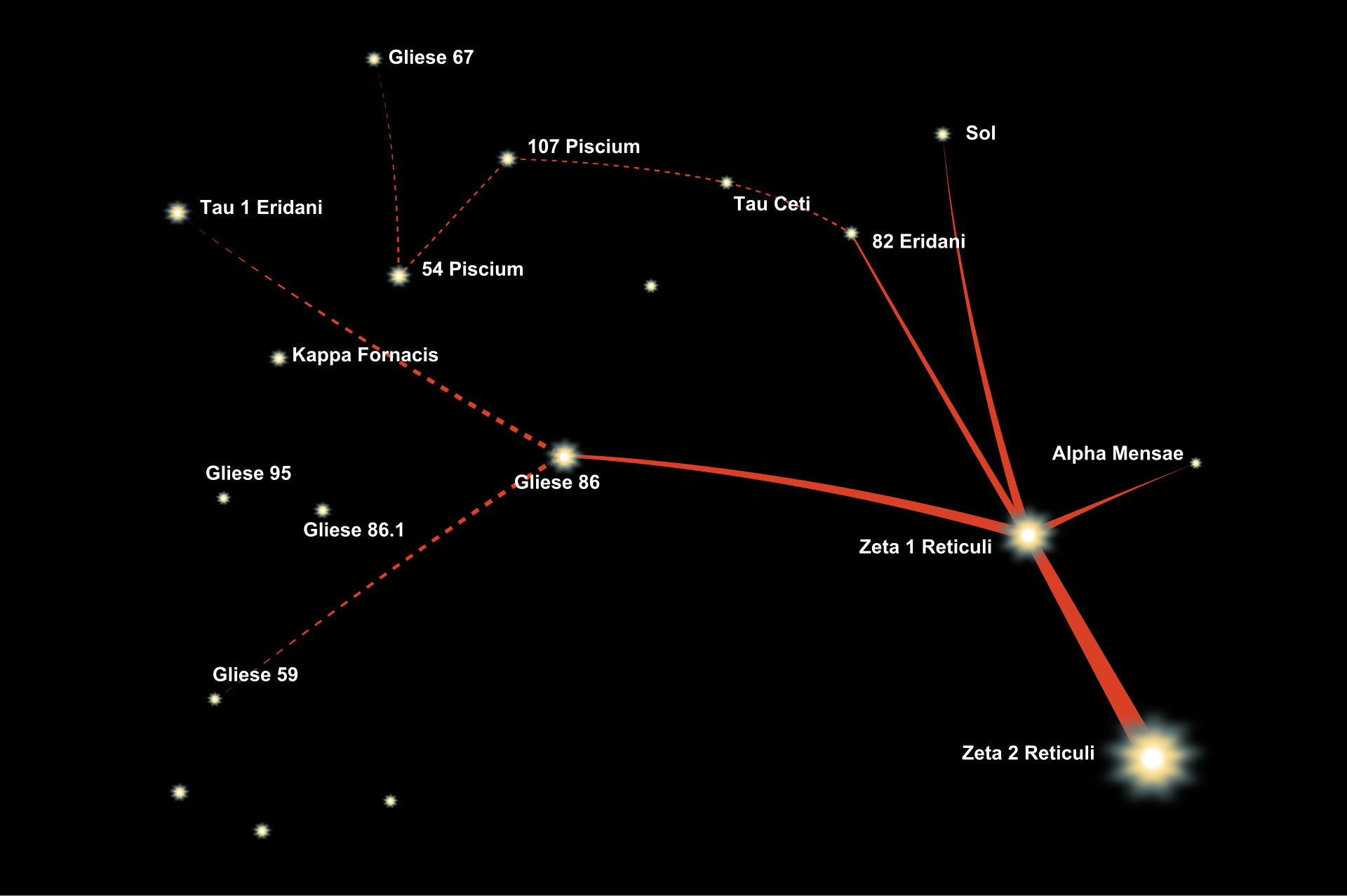
for the next fifty years, “zeta reticuli” lived in ufo/uap literature as the place aliens live.
it crossed into pop culture too. the derelict ship in alien (1979) sits on lv-426, a moon of a gas giant in the zeta ii reticuli system. ridley scott and dan o'bannon picked that address deliberately. by then, thanks to fish, it was already the canonical “where aliens come from” coordinates.
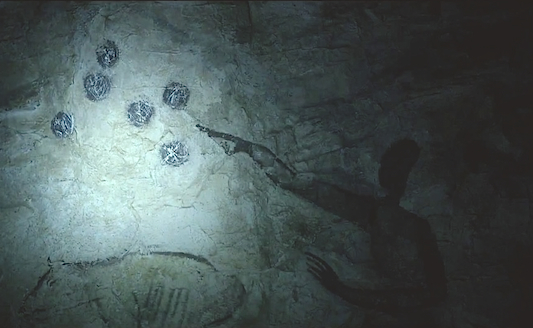
prometheus (2012) doubled down. the premise of the film is that the same star pattern shows up independently across the planet: in a skye cave painting, in mesopotamian tablets, mayan carvings, egyptian and hawaiian art. none of these cultures could have known about each other, and that convergence is the in-film evidence that someone really did leave the map.
the prometheus crew follows it to lv-223, a different moon in the same ζ² reticuli system, several decades before the events of alien. same star system, different gas giant, different moon. same canonical alien address.
the cave painting itself doesn't actually identify the star system. that connection is inherited from alien. but the visual echo of betty's scene, a human or human-like figure pointing at a map of stars, is hard to miss.
the first crack
fish used the 1969 gliese catalogue. we now have hipparcos and gaia, with parallax measurements typically ten to a hundred times more accurate. her fifteen stars were already loaded in star focus, so i pulled their modern distances and lined them up against the 1969 values.
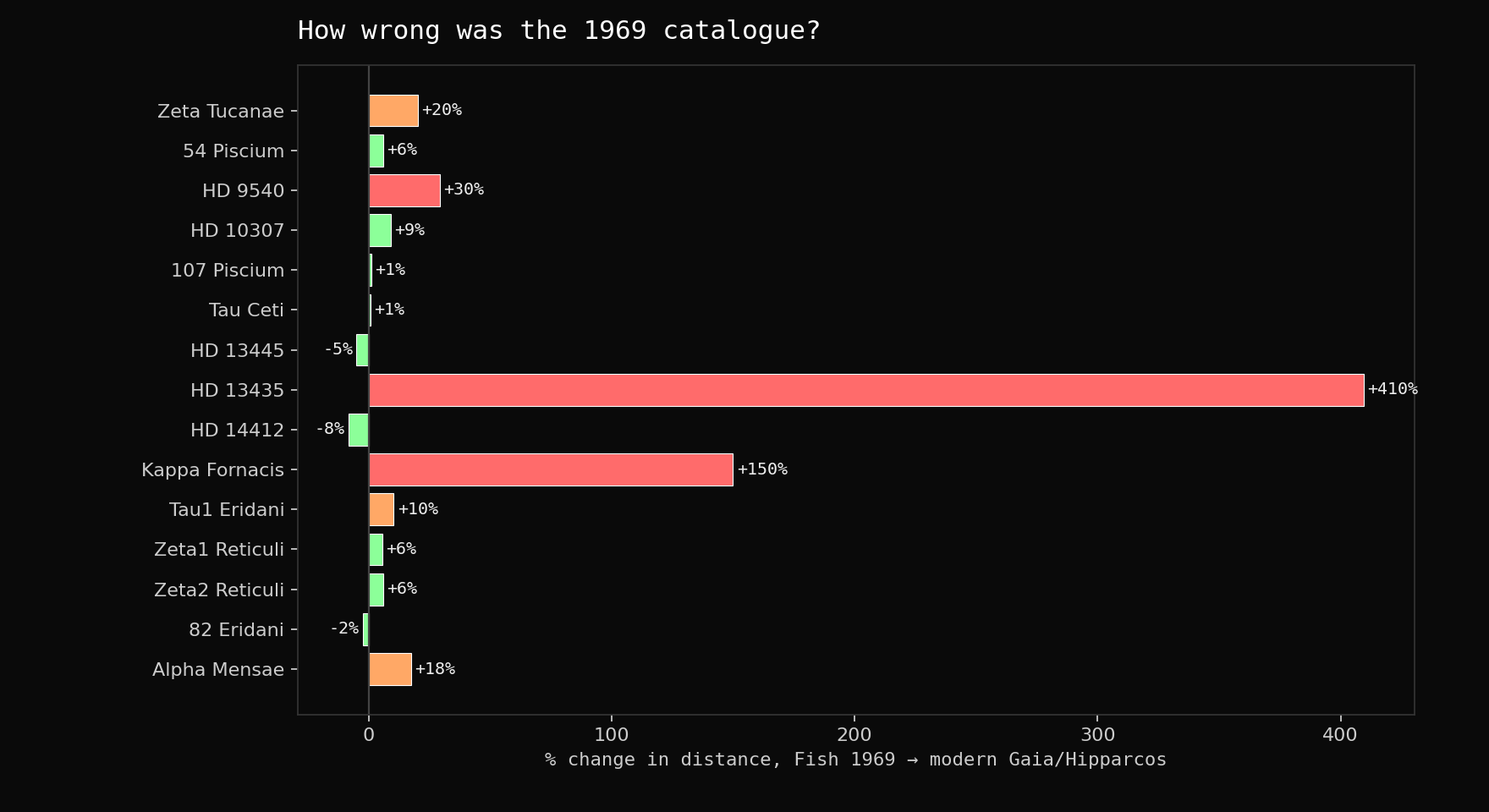
eight of fifteen are still roughly where she put them. two had small adjustments. and two were catastrophically wrong:
- kappa fornacis: 42 ly → 105 ly. +150%.
- hd 13435: 37 ly → 188 ly. +410%.
both stars sit near the centre of fish's arrangement. move them to where they actually are and the rest of the pattern stops holding together:
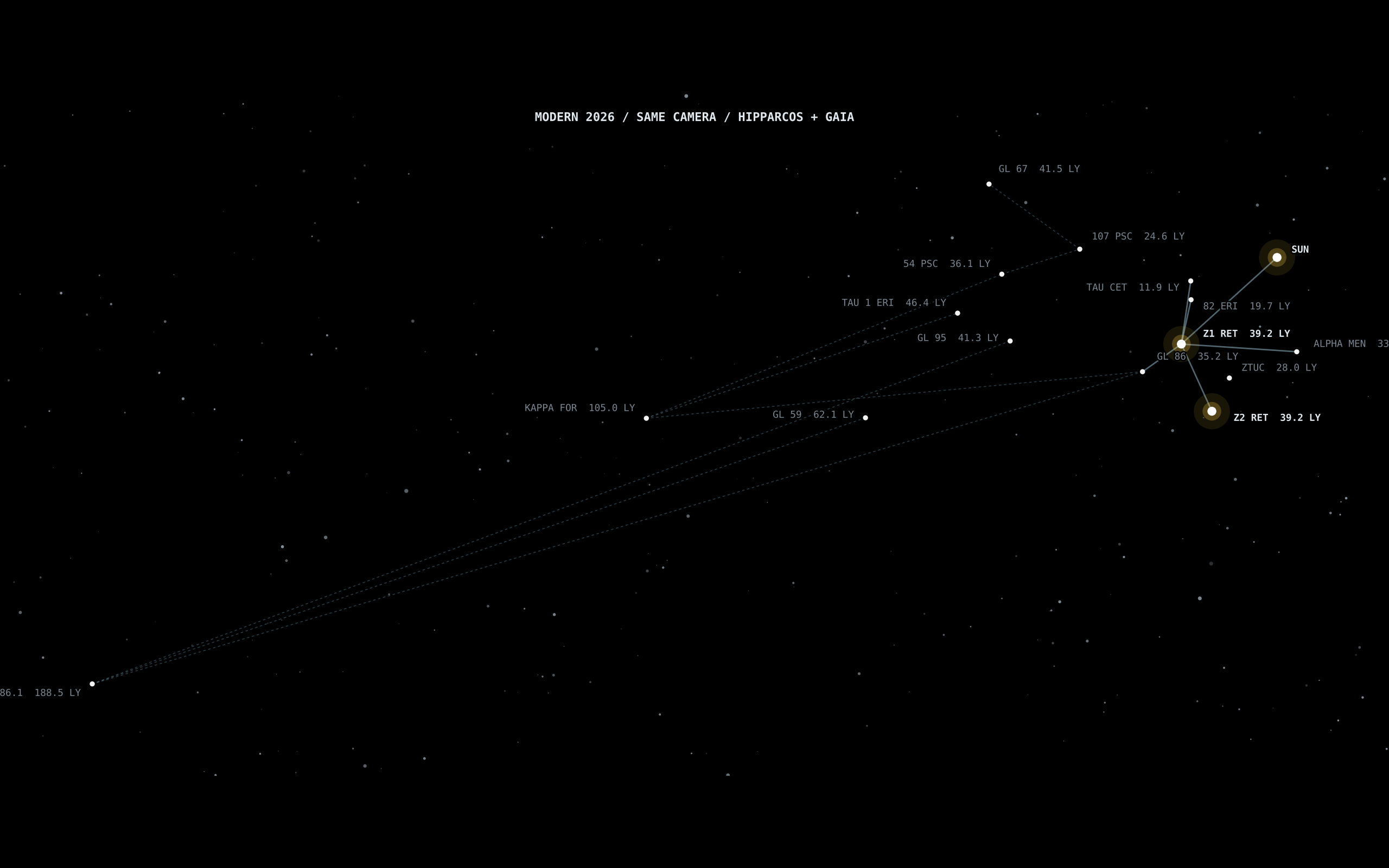
the hub holds. zeta¹ and zeta² barely moved, and tau ceti, 82 eridani, and 107 piscium are also close to where fish put them.
but kappa fornacis drops 60 light-years out of the plane, hd 13435 falls off the bottom of the diagram, and the “ring” fish identified is no longer a ring.
three experiments
fish's specific identifications don't hold up. but that doesn't actually close the question. three things could still be true, and each one needs its own experiment to rule out:
- maybe there is some other real viewpointin the nearby neighborhood that reproduces betty's pattern, even if it isn't reticuli and isn't the stars fish named. (or even: maybe the aliens really are from reticuli, but fish's 1969 catalogue was incomplete and the actual companion stars in her pattern just weren't in it yet.)
- maybe finding such a viewpoint means nothing, because with many thousands of stars to choose from you could fit any random 21-dot pattern onto the sky almost anywhere.
- maybe my search algorithm is just bad, and even when a correct viewpoint exists somewhere in the catalogue it would fail to find it.
three open questions. one experiment for each.
test 1. search the entire neighborhood
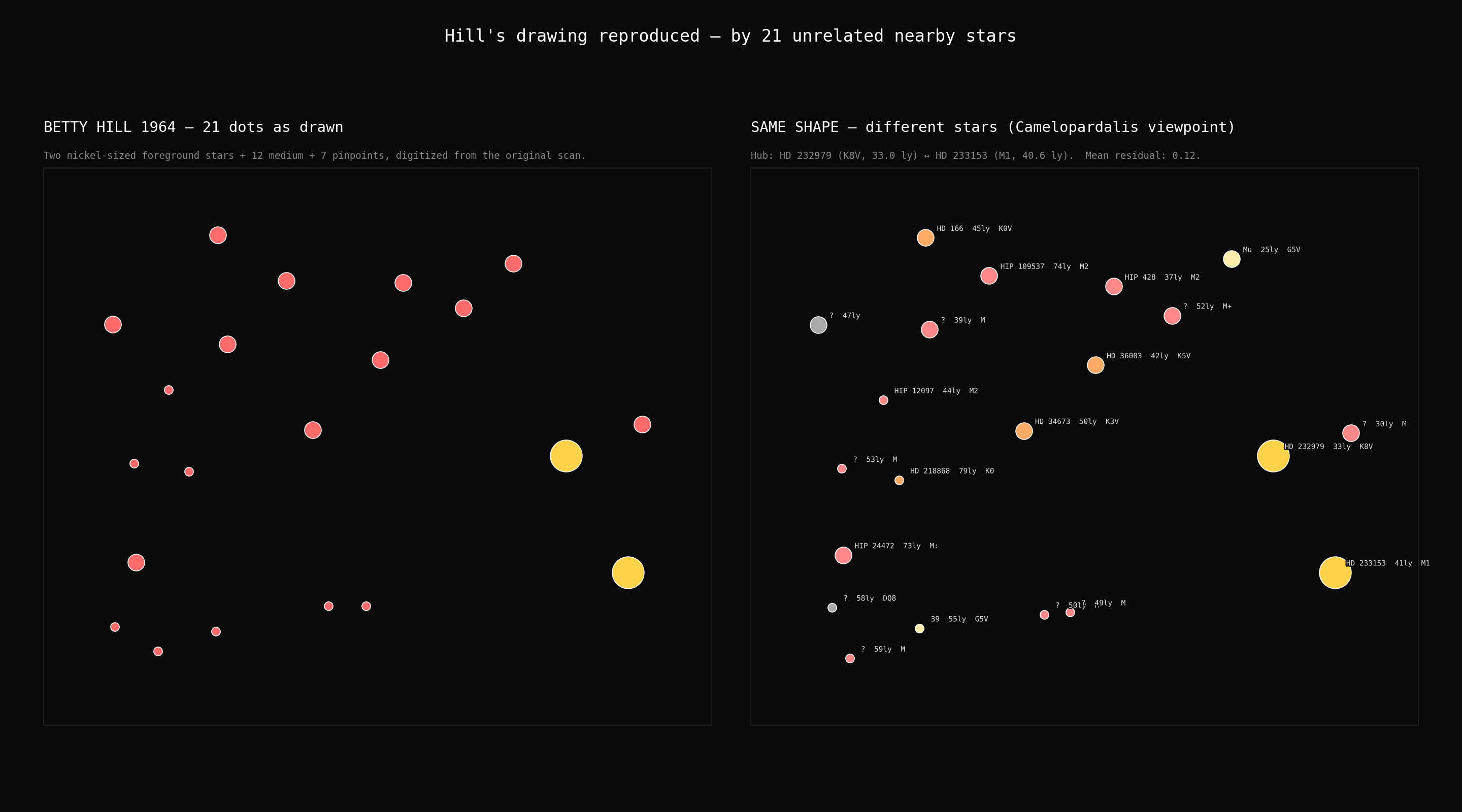
i took betty's drawing, the actual 1964 scan, and digitized all 21 visible dots by hand.
then i asked the algorithm: find any viewpoint anywhere within 82 light-years that reproduces this pattern. full hipparcos and gaia catalogue, all spectral classes, no filters. thousands of candidate stars.
the best match was very tight, mean residual 0.12 in drawing units. the hub turned out to be hd 232979 and hd 233153, two cool dwarfs in camelopardalis. about 33 and 41 light-years from the sun respectively, and roughly 65 light-years from ζ reticuli.
about as far from reticulum as you can get on the sky.
test 2. random 21-dot patterns
if “very tight match” actually means something, then a random pattern of 21 dots shouldn't fit nearly as well. so i generated twenty random 21-dot patterns, same number of dots, scrambled into different arrangements, and ran the search on each one.
| best residual | |
|---|---|
| hill drawing pattern | 0.121 |
| random patterns, median | 0.347 |
| random patterns, best of 20 | 0.087 |
betty's drawing is not distinguishable from any random arrangement of 21 dots projected onto our neighborhood.
test 3. synthetic ground truth
maybe my search algorithm is just bad. so i built a calibration.
i picked a real binary, hd 79210 and hd 79211, two k-dwarfs about 28 light-years away in ursa major. from a viewpoint right between them i projected the 21 nearest naked-eye-bright stars onto a plane and wrote them down. that gave me a synthetic “hill drawing” with a known answer.
then i ran the search on it.
| synthetic (answer known) | hill drawing | |
|---|---|---|
| best residual found | 0.096 | 0.121 |
| recovered the true viewpoint? | no | n/a |
| hub-pairs within 1.5× of best | 134 | 43 |
134 different hub pairs scored within 1.5× of the best. hill's drawing actually has fewer near-ties than the synthetic case. but both have plenty.
so what does this mean
the 1973 fish interpretation worked only because she had restricted herself to about 50 sun-like stars from the 1969 catalogue. inside that narrow search space, the geometry looked striking. in the full modern catalogue, you can find a hundred equally pretty fits and none of them mean anything.
this isn't a failure of betty hill's memory, or of the search algorithm. it's a fundamental information-theoretic limit. 21 anonymous dots in 2d simply under-determine a 3d viewpoint among thousands of candidates. there aren't enough constraints. there never will be.
what's actually solvable
the interesting part is that the problem is solvable. just not from this data.
if the aliens had given betty a high-resolution photograph instead of a sketch, which would have given us a brightness and a color for each star, or even just fifty stars at accurate positions instead of twenty-one, we would identify the viewpoint to within a fraction of a light-year.
the key word there is accurate. betty was drawing from a memory reconstructed under hypnosis, three years after the fact. some of those 21 dots are almost certainly in the wrong place, and some are probably missing entirely. a sketch from memory is not the same kind of object as a photograph or a star tracker frame.
a version of this is already routine on earth. astrometry.net plate-solves astrophotographs in seconds, and spacecraft star trackers do the same in flight. both solve a simpler problem, the camera sits near earth, they only need to recover its orientation. an alien-sky photo would be harder, because the viewpoint is unknown too: position and orientation together, six unknowns instead of three.
but with enough stars in the frame, each with a brightness and color, this is still tractable. the brightest stars in the sun's neighborhood, the ones that would dominate any photo taken from anywhere inside ~100 light-years, have already been measured precisely by the gaia space telescope. each one has a kind of unique fingerprint: distance, absolute brightness, color. from a new viewpoint they look different, but they're still the same individual stars. once a few of them are identified in the photo by their fingerprints, the viewpoint falls out of the geometry directly.
it would take an afternoon.
so the moral isn't “alien star maps are unfalsifiable.” it's narrower. betty hill's drawing in particular, with the information it actually contains, does not encode a location. whatever she was remembering, 21 dots without additional data won't tell us where it was.
if aliens ever decide to take you for a ride on their starship, ask for an accurate map. better, ask for a photograph. or, if they fly you all the way to their home planet, take a few shots of their night sky with your iphone and send them to me when you get back. we'll work out where you were taken within minutes.
all star positions from hyg v4.1 (hipparcos + gaia dr2/dr3). the 1973 identifications are verbatim from marjorie fish's published list. hill drawing dots digitized by hand from the 1964 scan. fish diagram by clementi, gregors, jam123 via wikimedia commons, cc by-sa 2.5.
the first and only focus timer flying between real stars at 10,000,000× the speed of light. you sit still. the starship does the rest.