project hail mary's real address
so project hail mary is out — the new ryan gosling sci-fi film, based on the andy weir novel. if you've seen the trailer, you've seen a man wake up in a spaceship somewhere in deep space, with no memory of how he got there. crew dead. amnesia. alien turning up later. classic weir.
here's the part the trailer doesn't tell you: every star in the story is a real star. you can look them up. they're on every astronomy map. they're in the sky tonight, if you stand outside and look in the right direction.
so the honest question is — would you actually want to go there?

first stop · tau ceti
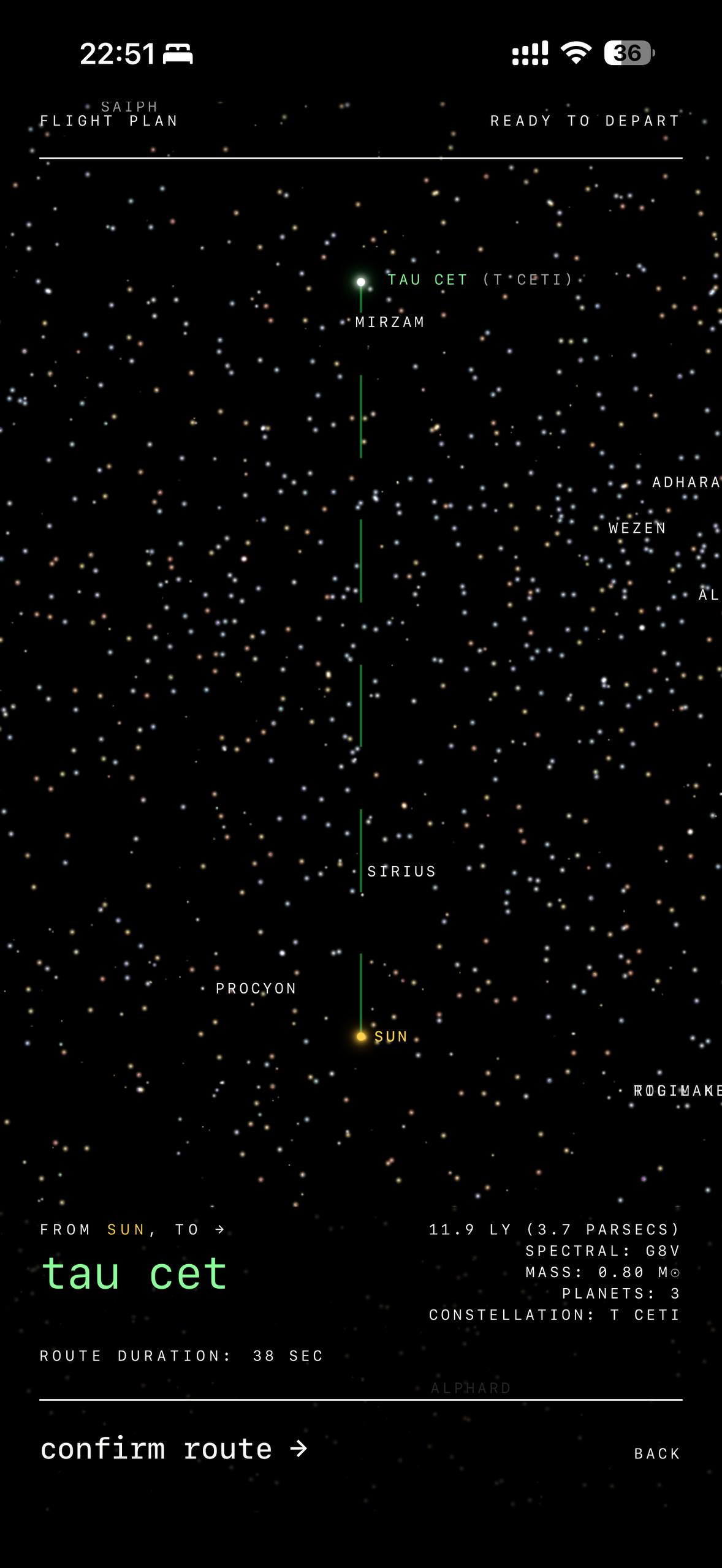
the ship is sent to tau ceti. a real star, 11.9 light-years from earth, sun-like, slightly older than the sun, slightly metal-poor. you can see it with the naked eye from the southern hemisphere — not bright, but there.
and tau ceti actually has known planets — four super-earth candidates are listed for it in the nasa exoplanet archive, two of them sitting in or near the star's habitable zone. weir didn't have to invent a place to send his ship.
in the book, tau ceti is the only nearby star not being consumed by an interstellar microorganism called astrophage. everywhere else, the local stars are dimming. so they send the hail mary there because if there's any survivor of whatever astrophage is, it has to be at the only sun still on.
weir doesn't hand-wave the journey. the ship runs at 1.5g of constant thrust — astrophage gives you that kind of power — with the human crew in induced coma. ryland grace sleeps through about 4 years and 8 monthsof ship time. on earth's clocks, about 13 years pass, because at those speeds relativity starts to show up.
now: how long would that trip actually take with our current technology? voyager 1 is the fastest probe humans have ever launched on a path out of the solar system. it's moving at about 17 km/s. at that speed, tau ceti is about 210,000 years away.
two hundred and ten thousand years. a recognisable human evolving in africa is closer to our time than that.
second stop · keid
at tau ceti, grace meets rocky. an alien from a different solar system, sent by his own civilisation for exactly the same reason: astrophage is eating his star too. two species came to look for an answer in the same patch of nearby space and they happened to dock at the same star.
rocky's home is 40 eridani a, also called keid. 16.3 light-years from earth, and about 10 light-years from tau ceti — the two stars happen to sit close together in the southern sky. keid is a real k-type primary in a triple system with a white dwarf and a red dwarf as companions. small, old, quiet — the kind of star astronomers like, because there's been enough time for a long biosphere to develop.
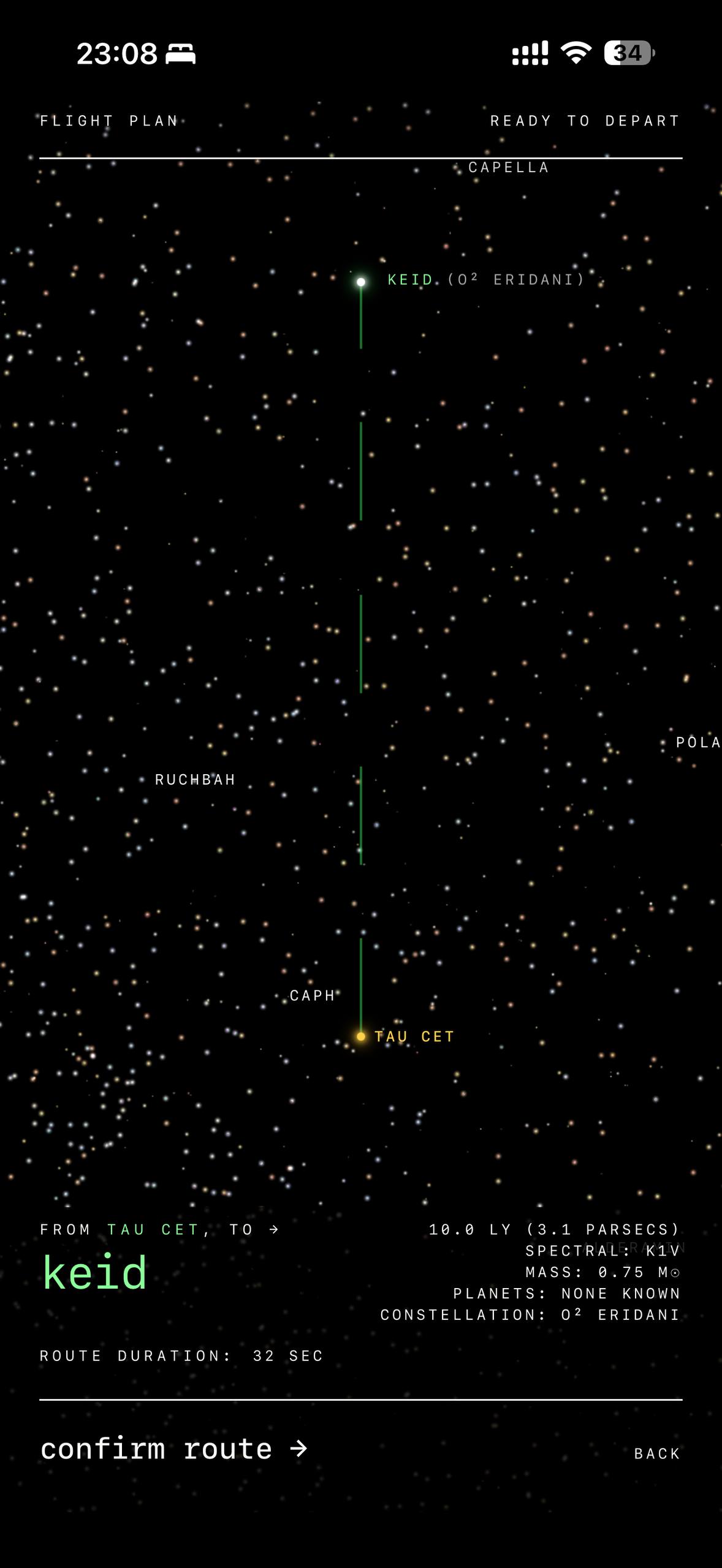
at the end of the book grace can't go back to earth, so he travels with rocky to keid instead. at voyager speed that second leg would take another ~177,000 years.
the star trek thing
side note. if you're a star trek fan you might already know keid, because vulcan orbits it. in 1991 gene roddenberry settled the question with a letter to sky & telescope, co-authored with three harvard astronomers. the choice has stuck across decades of canon. so when grace and rocky go to keid, they're going to the star spock comes from. real address, used twice, for completely different stories.
so. would you go?
honest answer for me — i don't know. five years of induced coma to wake up alone at a star nobody you knew is alive to remember, sounds like a lot. and the return trip in earth-frame time would put everyone you grew up with in the ground before you got back. weir is good at the math but the math is bleak.
but the addresses are real. that's what i keep coming back to. you can stand outside tonight, point yourself south and low to the horizon in the right month, and you're looking at the exact patch of sky where grace woke up. the light is there. it left a long time ago and it just happens to be hitting your eye right now.
the same trip, in our app
i make an ios focus app called starfocus. it flies you to a real nearby star during a focus session. you set a duration, the app picks a route, you fly. the catalogue is about 23,000 real stars from the hyg database — actual coordinates, actual distances. not random noise made to look like space.
the simulated cruise speed is 10 million times the speed of light. so:
| earth → tau ceti | about 38 seconds |
|---|---|
| tau ceti → keid | another 32 seconds |
| grace's full route, at voyager speed | about 387,000 years |
| grace's full route, in starfocus | about 70 seconds |
obviously 70 seconds isn't a focus session. tau ceti and keid were just the example for this article — they happen to be unusually close, so the flights are short. most of the 23,000 stars in the catalogue are much further out. you set a session length between 5 and 120 minutes and the app picks a star at the right distance for that block, so the flight time matches the work time. or you pick a star yourself by name and the trip adjusts to it.
you can fly to ambient music, to nature soundscapes, or in silence. whatever helps the work go. and starfocus now runs on ipad too — the bigger screen really changes the experience here, the field of real stars becomes something you actually want to sit inside for an hour at a time.
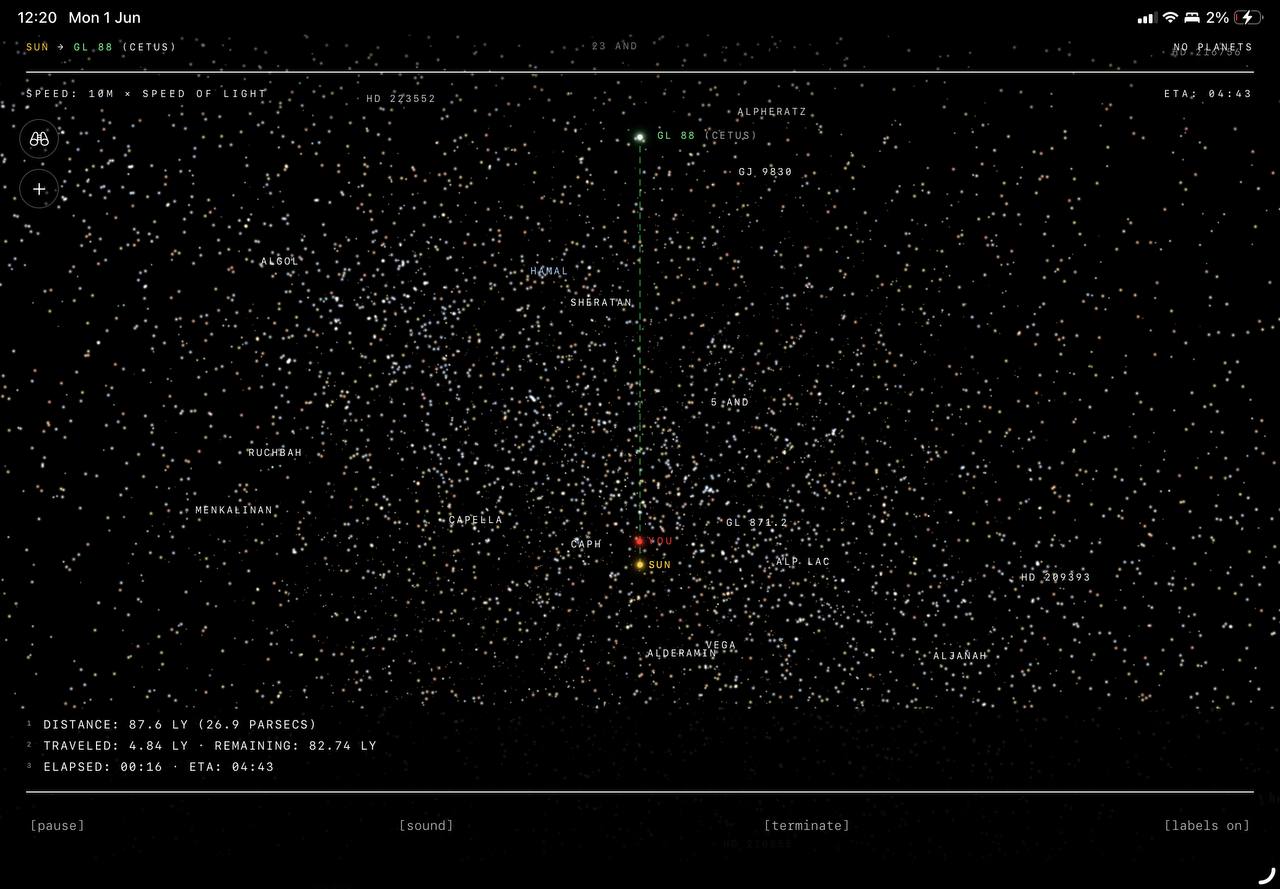
the first and only focus timer flying between real stars at 10,000,000× the speed of light. you sit still. the starship does the rest.